.jpg)


Guide to Vacuum Interrupters for Overcurrent Protection
When standard fusing reaches its capacity limits, you need a different way to protect your transformer. Learn how integrated vacuum interrupters compare to standalone switchgear for high-kVA applications.
Parts
When it comes to padmount transformer protection, bayonet fuses are the most common choice. They’re cost-effective, reliable, and easy to replace. However, in most cases, bayonet fuses can’t protect transformers rated 3,000 kVA and higher.
In those situations, it’s common to move fusing outside of the transformer, like in a standalone load interrupting switch. However, if you want to keep the fusing inside the transformer, you could use an integrated vacuum interrupter.
In this article, we’ll look at what vacuum interrupters are, how they work, and how they compare to standalone switchgear units.
What is a vacuum interrupter?
A vacuum interrupter is a switching and protection device that interrupts electrical current inside a sealed vacuum chamber. When a fault occurs, the contacts separate within the vacuum chamber interrupting the flow of fault current.
Vacuum interrupters are commonly used in medium-voltage systems. Unlike a fuse, which permanently blows during a fault, a vacuum interrupter trips to isolate the problem and can be reset once the issue is resolved. They are also smaller in size than an air-insulated fuse switch at higher voltages like 35kV.
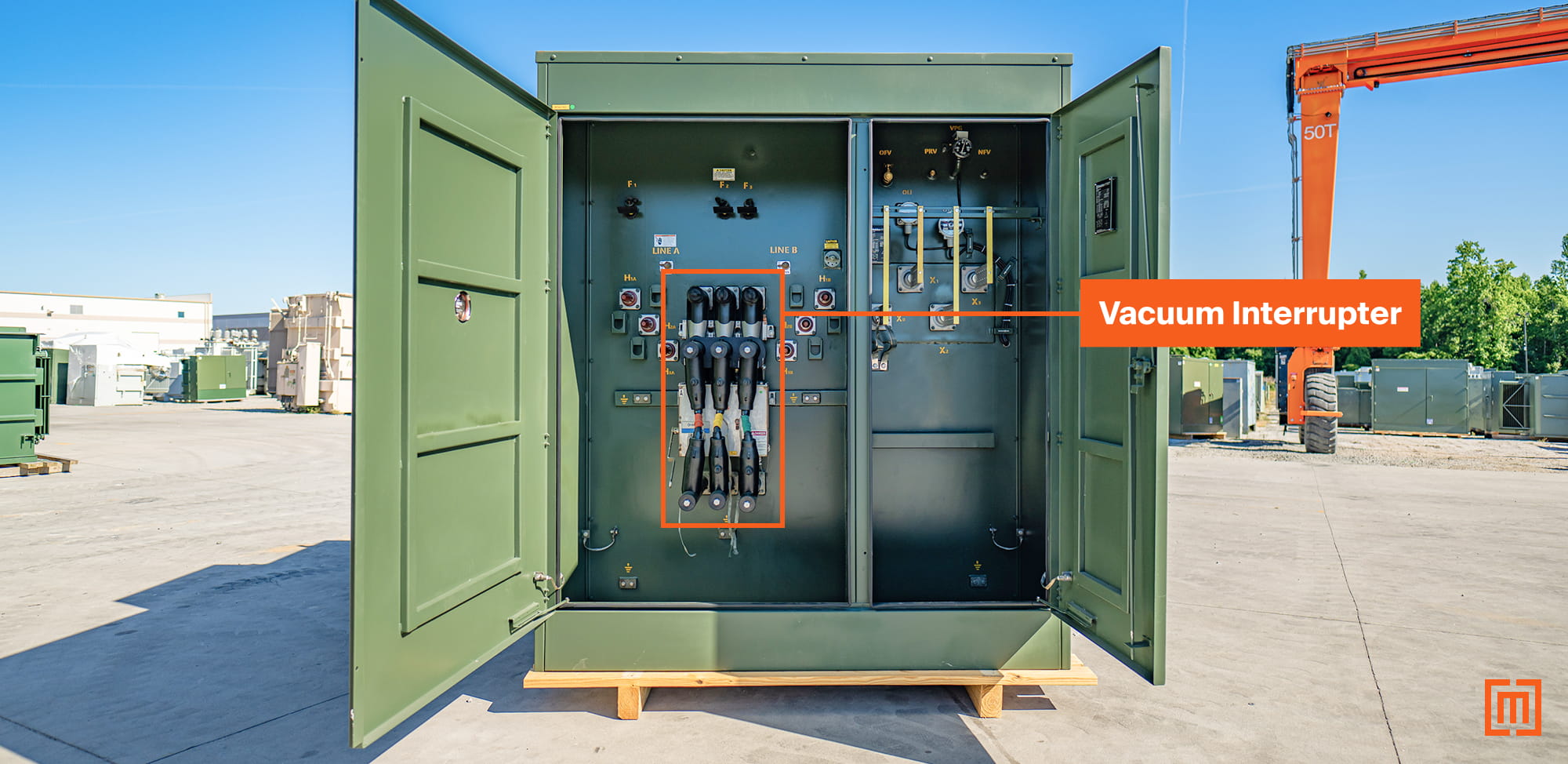
Key features of a vacuum interrupter
Because vacuum interrupters have intelligent, microprocessor controls, they offer forms of protection that a standard bayonet fuse can’t.
Here are the main features of a vacuum interrupter:
Three-Phase Gang Operation
When you protect a three-phase system with bayonet fuses, a fault might blow only one fuse and leave the other two live. A vacuum interrupter eliminates this risk entirely. Its three interrupters are mechanically linked together. If the system detects a fault on just one phase, it immediately trips all three phases at once to keep your equipment safe.
.jpg)
Smart Controls and Event Data
Unlike a purely mechanical fuse, vacuum interrupters use intelligent microprocessor controls. This lets operators set very specific trip settings which allow the transformer to coordinate with other protective devices.
Some versions of the vacuum interrupter have advanced communication ports that allow you to reconfigure radial or loop-feed transformers remotely. Vacuum interrupters can also record large amounts of data from historical events. This record helps techs review the events to determine the causes of problems.
Overcurrent Recognition
When a transformer is first energized, it draws a massive, sudden surge of power called inrush current. A standard bayonet fuse may treat this surge like a fault and trip. However, vacuum interrupters can be programmed to recognize inrush current so they only trip when real overcurrent actually happens.
.jpg)
Those are the basic features of a vacuum interrupter. Now let’s see how they compare to switchgear.
When to use Vacuum Interrupters vs. Switchgear
If your transformer is over 3,000 kVA, bayonet fuses are usually off the table, simply due to limitations in bayonet fuse current ratings. To get the overcurrent protection you need, there are two common options. You could install a separate standalone fused disconnect switch, or you could buy a transformer with an integrated vacuum interrupter.
.jpg)
Here’s a quick summary of those two approaches:
Considering Space and Cost
Using an integrated vacuum interrupter can save you the cost and space of a switchgear. Even though the transformer may cost more upfront, you’ll be saving space and reducing overall project costs from buying and installing a switchgear.
Also, vacuum interrupters are designed to last over 30 years. And tested to clear up to 2,000 faults. You can reset the device after a fault. No replacing blown bayonet fuses.
Conclusion
Transformer overcurrent protection depends on the size of the transformer, the system design, and the project requirements.
If your transformer is under 3,000 kVA, bayonet fuses are the practical, industry-standard choice. But if you are dealing with higher-kVA ratings, fuses are no longer an option. An integrated vacuum interrupter can save you cost and space. You’ll have advanced protection, unit monitoring, and a device that can be reset rather than replaced. All with simpler installation and a smaller footprint.
At Maddox we offer both standalone switches and transformers with vacuum interrupters installed.
If you need either of these options, fill out the form below.


