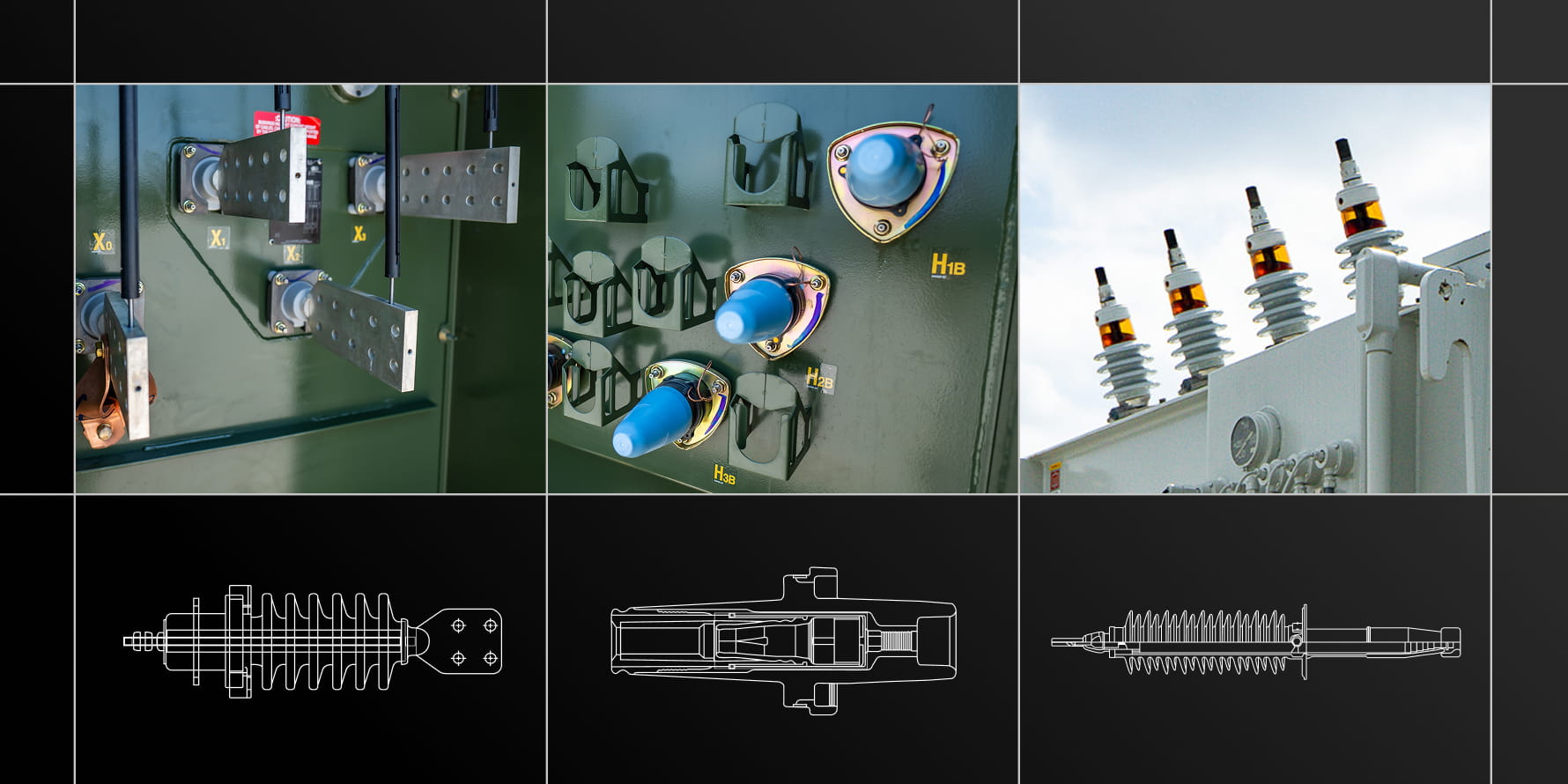
graphic of types of substation bushings

Guide to Transformer Bushings

Learn what transformer bushings are, how they work, their two main types (dead-front and live-front bushings), and when each type works best in padmount and substation transformers.

January 29, 2026

Transformer bushings play a fundamental role in the electrical system. They provide a safe and reliable connection point for the cables coming in and out of the transformer. 

In this article, we’ll cover:

  • What transfomer bushings are, and how they work,
  • Common types of dead-front and live-front bushings,
  • Bushing interfaces and installation considerations, and 
  • Why having the right bushing matters.

Let’s get into it. 

What are transformer bushings?

A bushing is a connection point on the transformer. It’s where the incoming or outgoing cables connect through the transformer enclosure or tank to the core and coils

Primary and secondary padmount bushings

What do transformer bushings do? 

Transformer bushings create a safe path for current flow. They do this by isolating current from touching anything it shouldn’t. (Such as the enclosure.) Power flows through bushings into the transformer’s windings, and then out of bushings to the load. Bushings guide the current flow to lower the risk of ground faults. This helps prevent arcing, fires, and other catastrophic failures.

Considerations When Choosing Bushings

It’s critical that the bushings match the transformer’s voltage and current ratings. Bushing location is also key. Some bushings are mounted inside an enclosure, like a padmount. Others are exposed outside the tank, like on some substations. In padmounts, you can also get different bushing layouts: loop feed or radial feed

Whatever bushing you use must be able to handle the mechanical, dielectric, and environmental stress of their applications. Bushing short-circuit and dielectric-withstand ratings must meet or exceed a system’s requirements.

Types of Transformer Bushings 

So that’s what transformer bushings do. But what types of bushings are out there? A lot.

For this article, we’ll keep things simple. Let’s look at the two main categories of bushings (live-front and dead-front), and how they show up on standard types of transformers. 

examples of live-front and dead-front bushings

Let’s start with dead-front bushings. 

Dead-Front Bushings 

Dead-front bushings are called “dead” because they provide a fully-insulated termination for cables. The insulation gives additional protection against arc-flash. You’ll find these on padmount transformers, usually on the primary (high voltage) side. 

Now, to be clear, bushings on the high voltage side could be either live-front or dead-front. But they’re usually dead-front. Why is this? 

  • Reduced air clearance requirements 

    • Lower voltages require less air clearance (or space between bushings). Higher voltages require more. Dead-front bushings reduce the amount of air clearance and cabinet space required in padmounts. This means they are usually on the high voltage side to allow for a smaller cabinet size.
  • Safety

    • Secondly, dead-front bushings offer a completely insulated cable connection at the transformer. This makes it safer for maintenance and utility workers when the cabinet is open.

Loadbreak vs. Deadbreak Bushings

Dead-front bushings come in two types: loadbreak and deadbreak. Let’s start with loadbreak. 

Loadbreak Bushings

Loadbreak bushings allow you to disconnect cables (or “break the load”) while the transformer is under load. This is usually done with a hot stick. 

Let’s look at a 200-amp loadbreak interface as an example. 

Diagram of 200 amp loadbreak interface

In this diagram, moving from left to right: 

  • The cable carrying a high voltage 
  • attaches to an elbow
  • that then connects to the bushing. 
  • The bushing consists of a threaded insert, 
  • a clamp, 
  • and a well. 

For guidelines on installing these elbows, check out our installing 200-amp elbows article. If you’d like more details on the individual bushing types, read our types of padmount transformer bushings article

Let’s move on to deadbreak bushings. 

Deadbreak Bushings

If your current rating exceeds 200 amps, you need a 600-amp deadbreak bushing. Deadbreak bushings require the transformer to be de-energized before any cables can be connected or disconnected. 
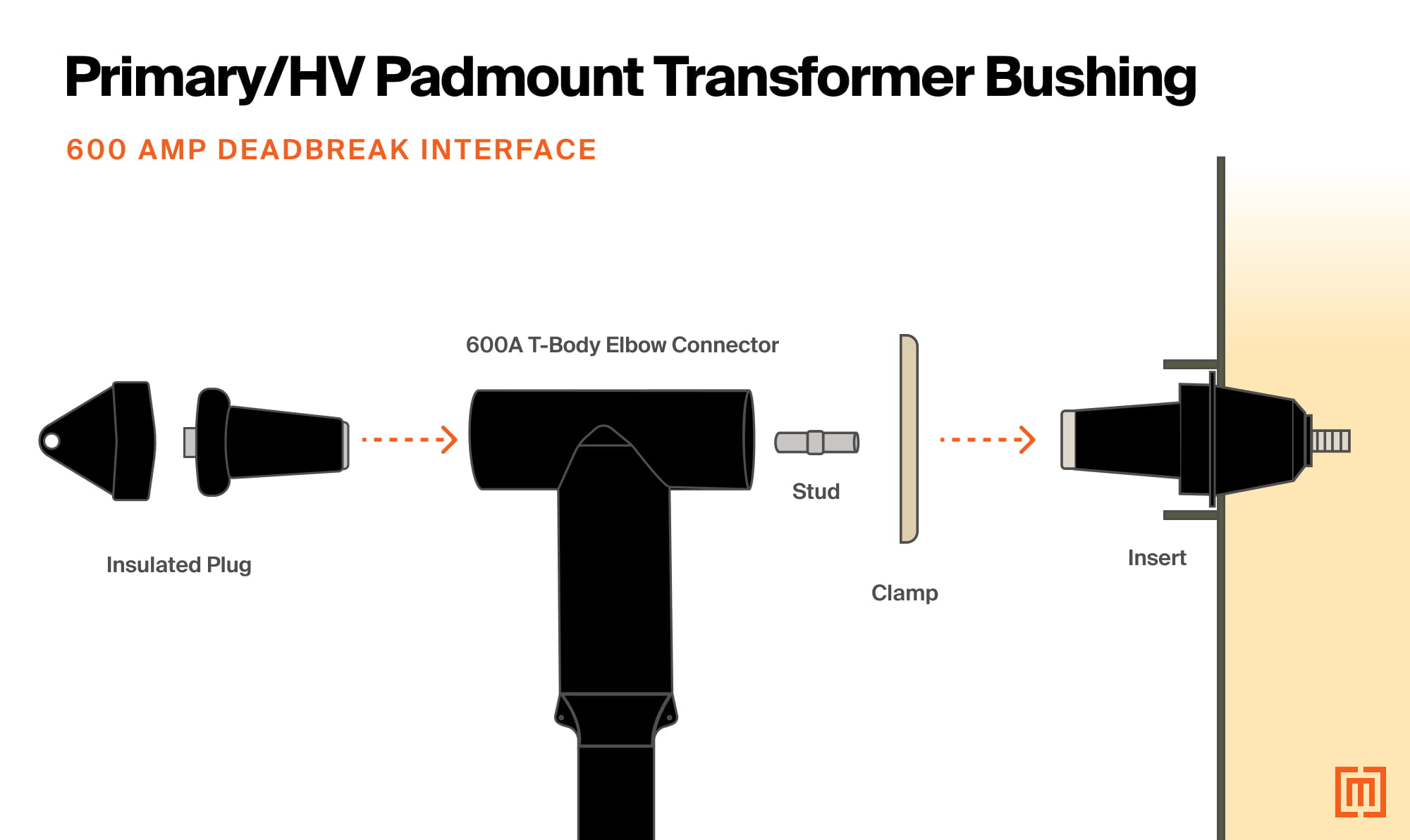
diagram of 600 amp deadbreak interface

For dead break installation instructions, check out our article on installing 600-amp t-body elbows

Now that we’ve covered the enclosed and insulated style of bushings, let’s look at the exposed and higher-clearance style. These are live-front bushings. 

Live-Front Bushings

Live-front bushings have exposed terminals (the place where you connect your cable). It’s “live”. This means the conductor doesn’t have any insulating material covering it. If you touch it–or even get close to it–you run the risk of serious harm. 

Live-front bushings are usually found on:

  • Substation transformers
  • Sometimes on the primary side of padmount transformers

These bushings come in two main categories: solid and condenser. Let’s start with solid. 

diagram of types of live-front bushings

Solid Bushings

Solid bushings use epoxy or porcelain to insulate the conductor. The thickness of this insulation is what provides the needed dielectric strength. Their simple design works well for lower‑voltage windings.

solid bushing diagram

6-Hole and 12-Hole Spade Bushings

For transformers with low voltage secondaries 600 volts and below, bushing size increases with the size of the transformer kVA. A 500 kVA transformer will typically have at least 4-hole spades. And a 2,500 kVA transformer could have 10 or more holes per spade. The greater the current at the secondary bushings, the more connected cables at each spade. 

graphic of 6-hole and 12-hole spades

Bushing supports help bear the additional weight of multiple cables attached to one bushing. You can also use spade extensions to increase the lug capacity of your transformer. 

Now let's look at the other type of live front bushing. 

Condenser Bushings

Condenser (or capacitance-graded) bushings contain layers of conductive material between the bushing’s conductor and the housing of the insulator. This stack of layers spreads the voltage field evenly around the bushing’s conductor. Condenser bushings also use oil impregnated paper (OIP) or resin impregnated paper (RIP) insulation. They are typically used for higher voltage windings. As a rule, you won’t see these on systems below 25kV. 

Condenser bushings require greater care and maintenance than solid-type bushings. They typically include a test tap and stress shield. These allow you to perform diagnostics on bushing health without taking it apart.  

There are two main types of condenser bushings: draw-lead styles and draw-rod styles. Let’s quickly look at both. 

Draw-Lead Style Bushings

Draw-lead bushings are condenser bushings designed so that the internal conductor is a flexible cable (the “draw lead”) rather than a solid rod. The draw lead is pulled through the bushing and connected to the transformer internal winding lead using a removable connector.

A draw-lead style termination keeps the conductor independent of the bushing’s insulator. In other words, the conductor is not built-in to the bushing.

diagram of draw-lead bushing

Draw-Rod Style Bushings

Draw-rod bushings feature a rigid conductor rod running through the bushing, which can be withdrawn during maintenance—hence the “draw-rod” name. Unlike a draw-lead bushing, the conductor is a solid bar rather than a flexible lead, allowing for higher current ratings.

diagram of draw-rod bushing

Choosing the Right Transformer Bushing

At the end of the day, the right bushing comes down to the voltage, current, and termination needs of the project.

Some bushings can't be used on every transformer design. For example, dead-front loadbreak style bushings offer a maximum current rating of 200 amps. If you need a dead-front design on a padmount with a current rating above 200 amps, loadbreak isn’t the way to go.

Another example would be having a 1500 kVA padmount with a 4.16kV primary. Your only dead-front option for this kind of unit would be to use a 600 amp deadbreak bushing. 

Limitations of Dead-Front and Live-Front Bushings on Padmounts

Most dead-front bushings are only rated up to 35 kV. Above that, you must use live-front bushings. Live-front designs require large air clearances, which don’t work well in padmounts at that higher kV. It’s possible to use live-front bushings at 35–46 kV, but it’s usually not the best option. And using live-front bushings for 69kV applications is out of the question in a padmount cabinet or enclosed termination chamber. That's when you’ll need to look at a substation transformer.

Cable terminations are another factor to consider. There are a wide variety of bushing termination styles. You’ll want to have the one that works best for the size and number of cables connected to the transformer. 

Conclusion

Always make sure to thoroughly review the specs for your specific project to make sure you get the right transformer and bushings.

If you need a transformer with any of the bushing types or styles above, reach out to Maddox.

We have thousands of transformers in stock and ready to ship from yards across the country. Backed by a team of engineers and customer service representatives dedicated to getting you the right transformer fast.

Written by:
Matt Estelle and Ben Gulick
A Maddox Padmount transformer loaded on a truck and shipping out

Get in touch

Find out how Maddox can power on your next project.
Thank you!
Your submission has been received!
Oops! Something went wrong while submitting the form.
All Articles

Guide to Transformer Bushings

Learn what transformer bushings are, how they work, their two main types (dead-front and live-front bushings), and when each type works best in padmount and substation transformers.

Written by:
Matt Estelle and Ben Gulick

January 29, 2026

graphic of types of substation bushings

Transformer bushings play a fundamental role in the electrical system. They provide a safe and reliable connection point for the cables coming in and out of the transformer. 

In this article, we’ll cover:

  • What transfomer bushings are, and how they work,
  • Common types of dead-front and live-front bushings,
  • Bushing interfaces and installation considerations, and 
  • Why having the right bushing matters.

Let’s get into it. 

What are transformer bushings?

A bushing is a connection point on the transformer. It’s where the incoming or outgoing cables connect through the transformer enclosure or tank to the core and coils

Primary and secondary padmount bushings

What do transformer bushings do? 

Transformer bushings create a safe path for current flow. They do this by isolating current from touching anything it shouldn’t. (Such as the enclosure.) Power flows through bushings into the transformer’s windings, and then out of bushings to the load. Bushings guide the current flow to lower the risk of ground faults. This helps prevent arcing, fires, and other catastrophic failures.

Considerations When Choosing Bushings

It’s critical that the bushings match the transformer’s voltage and current ratings. Bushing location is also key. Some bushings are mounted inside an enclosure, like a padmount. Others are exposed outside the tank, like on some substations. In padmounts, you can also get different bushing layouts: loop feed or radial feed

Whatever bushing you use must be able to handle the mechanical, dielectric, and environmental stress of their applications. Bushing short-circuit and dielectric-withstand ratings must meet or exceed a system’s requirements.

Types of Transformer Bushings 

So that’s what transformer bushings do. But what types of bushings are out there? A lot.

For this article, we’ll keep things simple. Let’s look at the two main categories of bushings (live-front and dead-front), and how they show up on standard types of transformers. 

examples of live-front and dead-front bushings

Let’s start with dead-front bushings. 

Dead-Front Bushings 

Dead-front bushings are called “dead” because they provide a fully-insulated termination for cables. The insulation gives additional protection against arc-flash. You’ll find these on padmount transformers, usually on the primary (high voltage) side. 

Now, to be clear, bushings on the high voltage side could be either live-front or dead-front. But they’re usually dead-front. Why is this? 

  • Reduced air clearance requirements 

    • Lower voltages require less air clearance (or space between bushings). Higher voltages require more. Dead-front bushings reduce the amount of air clearance and cabinet space required in padmounts. This means they are usually on the high voltage side to allow for a smaller cabinet size.
  • Safety

    • Secondly, dead-front bushings offer a completely insulated cable connection at the transformer. This makes it safer for maintenance and utility workers when the cabinet is open.

Loadbreak vs. Deadbreak Bushings

Dead-front bushings come in two types: loadbreak and deadbreak. Let’s start with loadbreak. 

Loadbreak Bushings

Loadbreak bushings allow you to disconnect cables (or “break the load”) while the transformer is under load. This is usually done with a hot stick. 

Let’s look at a 200-amp loadbreak interface as an example. 

Diagram of 200 amp loadbreak interface

In this diagram, moving from left to right: 

  • The cable carrying a high voltage 
  • attaches to an elbow
  • that then connects to the bushing. 
  • The bushing consists of a threaded insert, 
  • a clamp, 
  • and a well. 

For guidelines on installing these elbows, check out our installing 200-amp elbows article. If you’d like more details on the individual bushing types, read our types of padmount transformer bushings article

Let’s move on to deadbreak bushings. 

Deadbreak Bushings

If your current rating exceeds 200 amps, you need a 600-amp deadbreak bushing. Deadbreak bushings require the transformer to be de-energized before any cables can be connected or disconnected. 

diagram of 600 amp deadbreak interface

For dead break installation instructions, check out our article on installing 600-amp t-body elbows

Now that we’ve covered the enclosed and insulated style of bushings, let’s look at the exposed and higher-clearance style. These are live-front bushings. 

Live-Front Bushings

Live-front bushings have exposed terminals (the place where you connect your cable). It’s “live”. This means the conductor doesn’t have any insulating material covering it. If you touch it–or even get close to it–you run the risk of serious harm. 

Live-front bushings are usually found on:

  • Substation transformers
  • Sometimes on the primary side of padmount transformers

These bushings come in two main categories: solid and condenser. Let’s start with solid. 

diagram of types of live-front bushings

Solid Bushings

Solid bushings use epoxy or porcelain to insulate the conductor. The thickness of this insulation is what provides the needed dielectric strength. Their simple design works well for lower‑voltage windings.

solid bushing diagram

6-Hole and 12-Hole Spade Bushings

For transformers with low voltage secondaries 600 volts and below, bushing size increases with the size of the transformer kVA. A 500 kVA transformer will typically have at least 4-hole spades. And a 2,500 kVA transformer could have 10 or more holes per spade. The greater the current at the secondary bushings, the more connected cables at each spade. 

graphic of 6-hole and 12-hole spades

Bushing supports help bear the additional weight of multiple cables attached to one bushing. You can also use spade extensions to increase the lug capacity of your transformer. 

Now let's look at the other type of live front bushing. 

Condenser Bushings

Condenser (or capacitance-graded) bushings contain layers of conductive material between the bushing’s conductor and the housing of the insulator. This stack of layers spreads the voltage field evenly around the bushing’s conductor. Condenser bushings also use oil impregnated paper (OIP) or resin impregnated paper (RIP) insulation. They are typically used for higher voltage windings. As a rule, you won’t see these on systems below 25kV. 

Condenser bushings require greater care and maintenance than solid-type bushings. They typically include a test tap and stress shield. These allow you to perform diagnostics on bushing health without taking it apart.  

There are two main types of condenser bushings: draw-lead styles and draw-rod styles. Let’s quickly look at both. 

Draw-Lead Style Bushings

Draw-lead bushings are condenser bushings designed so that the internal conductor is a flexible cable (the “draw lead”) rather than a solid rod. The draw lead is pulled through the bushing and connected to the transformer internal winding lead using a removable connector.

A draw-lead style termination keeps the conductor independent of the bushing’s insulator. In other words, the conductor is not built-in to the bushing.

diagram of draw-lead bushing

Draw-Rod Style Bushings

Draw-rod bushings feature a rigid conductor rod running through the bushing, which can be withdrawn during maintenance—hence the “draw-rod” name. Unlike a draw-lead bushing, the conductor is a solid bar rather than a flexible lead, allowing for higher current ratings.

diagram of draw-rod bushing

Choosing the Right Transformer Bushing

At the end of the day, the right bushing comes down to the voltage, current, and termination needs of the project.

Some bushings can't be used on every transformer design. For example, dead-front loadbreak style bushings offer a maximum current rating of 200 amps. If you need a dead-front design on a padmount with a current rating above 200 amps, loadbreak isn’t the way to go.

Another example would be having a 1500 kVA padmount with a 4.16kV primary. Your only dead-front option for this kind of unit would be to use a 600 amp deadbreak bushing. 

Limitations of Dead-Front and Live-Front Bushings on Padmounts

Most dead-front bushings are only rated up to 35 kV. Above that, you must use live-front bushings. Live-front designs require large air clearances, which don’t work well in padmounts at that higher kV. It’s possible to use live-front bushings at 35–46 kV, but it’s usually not the best option. And using live-front bushings for 69kV applications is out of the question in a padmount cabinet or enclosed termination chamber. That's when you’ll need to look at a substation transformer.

Cable terminations are another factor to consider. There are a wide variety of bushing termination styles. You’ll want to have the one that works best for the size and number of cables connected to the transformer. 

Conclusion

Always make sure to thoroughly review the specs for your specific project to make sure you get the right transformer and bushings.

If you need a transformer with any of the bushing types or styles above, reach out to Maddox.

We have thousands of transformers in stock and ready to ship from yards across the country. Backed by a team of engineers and customer service representatives dedicated to getting you the right transformer fast.

A Maddox Padmount transformer loaded on a truck and shipping out

Get in touch

Find out how Maddox can power on your next project.
Thank you!
Your submission has been received!
Oops! Something went wrong while submitting the form.