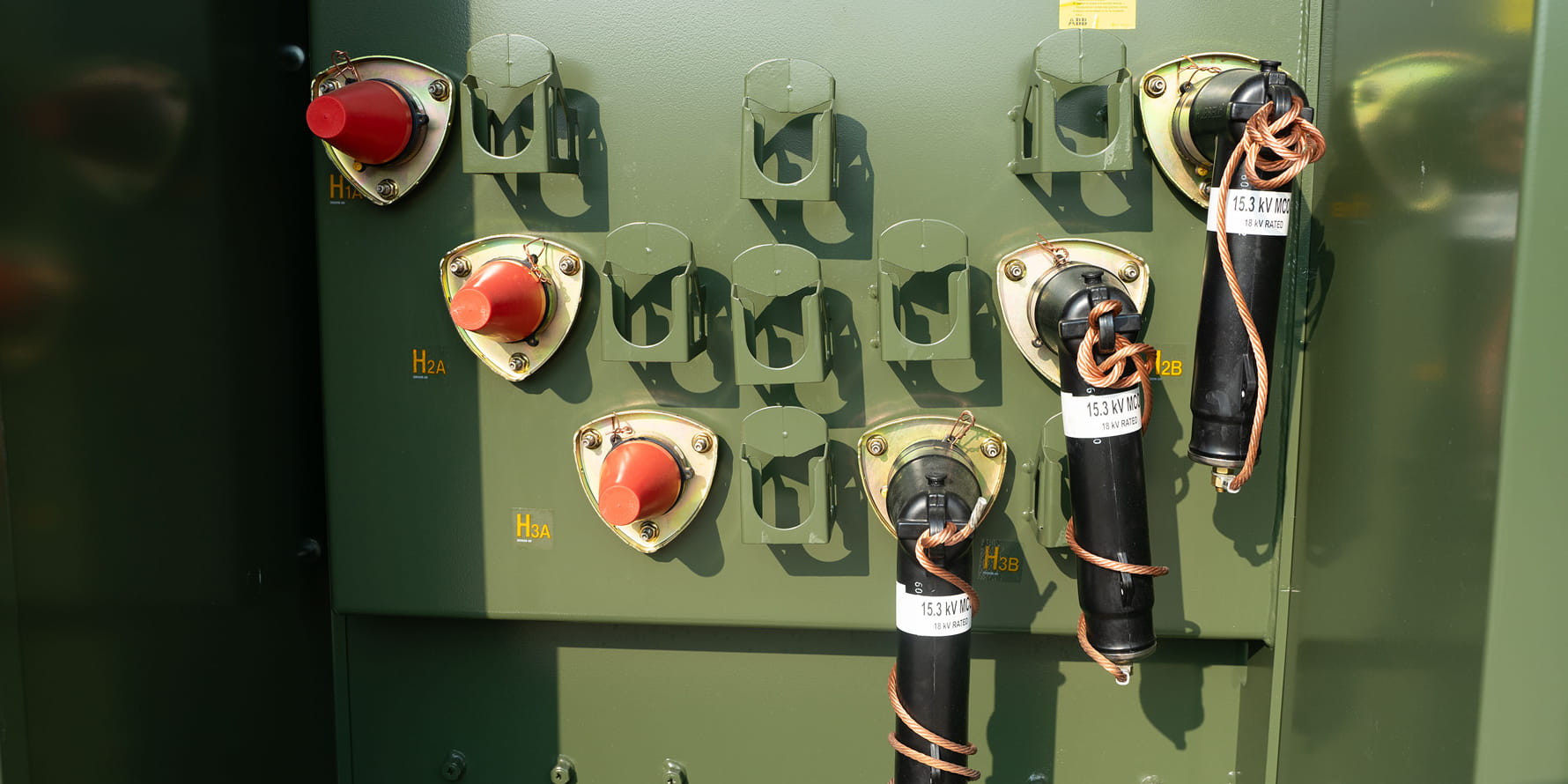
closeup of arresters on a green loop-feed padmount transformer

Transformer Arrester Guide: Types, Ratings & Protection

Learn how transformer arresters protect electrical equipment from lightning and switching surges, the main arrester types, and how to choose the right one.

‍Transformers do a lot of heavy lifting on the power grid. But they still need protection from electrical hazards if you want the power to stay on. Devices like Switchgear, vacuum interrupters, fuses, and surge arresters all help protect transformers and the electrical systems connected to them.

While fuses deal with overcurrent, arresters deal with large voltage spikes. 

Arresters do protect the transformer, but their main job is to protect the user’s load. (Whatever is consuming the power downwind of the transformer.) A transformer can often withstand a brief voltage surge, but the equipment connected downstream may be much more sensitive. Arresters help limit those surges before they damage the transformer or other connected equipment.

In this article, we’ll explain what transformer arresters are, how they work, the main types, and what to consider when choosing one.

What is a transformer arrester?

An arrester, also called a surge protector or a lighting arrester, is a protective device that limits temporary overvoltage in an electrical system. 

It works much like the surge protector you might use for your laptop or other electronics. When voltage suddenly rises above the normal level, the arrester redirects the surge to ground before it can damage connected equipment.

What does an arrester protect against? 

Surge arresters protect electrical equipment from large, temporary voltage spikes.

Two of the most common overvoltage sources are lightning surges and switching surges.

Lightning Surges

A lightning strike doesn’t have to hit your transformer to create a problem.

A strike on or near an overhead distribution line can create a traveling voltage wave that moves through the electrical system toward the transformer and connected equipment. Without adequate surge protection, that transient voltage can damage the electrical system. 
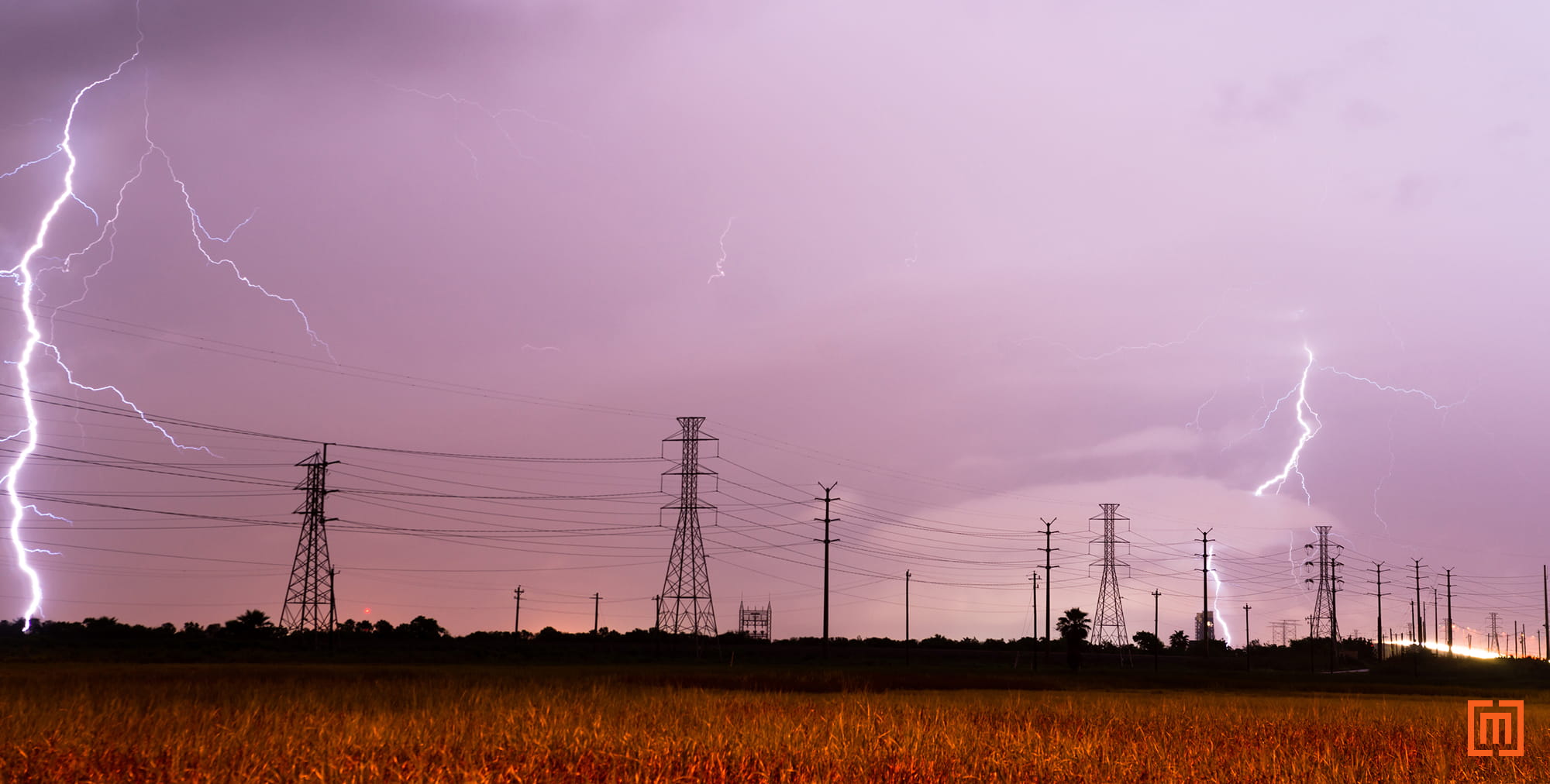
photo of lightning around power lines against a purple sky

This is why surge arresters are often referred to as lightning arresters.

Switching Surges

Opening and closing electrical circuits can also create temporary overvoltages.

Switchgear, capacitor banks, and other power-system equipment can produce transient voltage that travels through the system.

Surge arresters can help limit these overvoltages before they reach damaging levels. 

How do transformer arresters work? 

Under normal operating conditions, an arrester does very little.

When voltage suddenly rises above its normal range, the arrester responds by limiting, or “clamping,” the overvoltage by diverting the surge to earth ground.
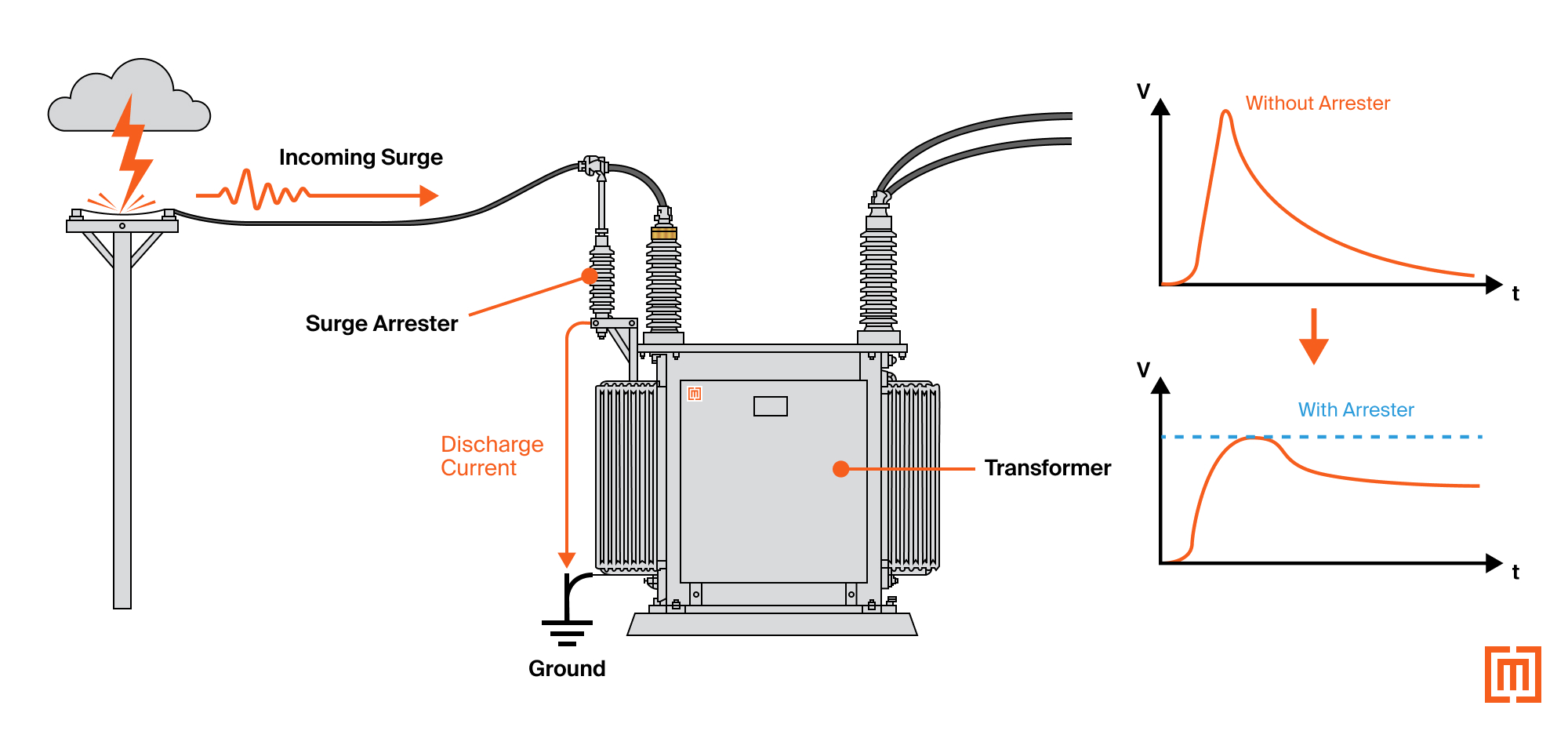
diagram of substation with arresters showing voltage diverted to ground

Metal Oxide Varistars

The part of the arrester that does this clamping and protecting is the metal oxide varistar or MOV. 

MOV blocks are designed to handle voltage surges within a specific range. When a large voltage surge reaches the arrester, the MOVs divert that surge to ground.

However, there is a limit to how much voltage and energy they can withstand.

Two important arrester ratings help define those limits:

  • Duty-cycle rating
  • Maximum Continuous Operating Voltage, or MCOV

Duty-Cycle Rating

MOV’s withstand rating, or duty cycle, is the voltage level an arrester is designed to withstand during short-duration overvoltage conditions.

When the temporary overvoltages are higher than the arrester’s duty cycle rating, the MOVs fail.

Maximum Continuous Operating Voltage

MOVs are also designed to handle the continuous normal system voltage. This is the voltage they experience within the standard supply voltage range. Exposing the MOVs to long periods of higher than normal voltages also causes failure. We call this rating the maximum continuous operating voltage (MCOV). 

Getting the right arrester requires correctly sizing the duty cycle and MCOV ratings. Otherwise, the arrester may not properly protect the transformer and electrical system. The higher the regular voltage is, the greater the potential overvoltage. 

What are the types of arresters?

There are three main types of arresters: distribution, intermediate, and station class. 

The table below has a quick breakdown of these different types.

Characteristic Distribution Class Intermediate Class Station Class
Applications Padmount & polemount transformers, riser poles, and standard overhead utility lines Small-to-medium substations, and medium-voltage equipment Large utility substations, and high-voltage transmission terminals
Voltage Range 1-36 kV 3-120 kV 3-684 kV
Short-Circuit Rating Up to 20 kA (20,000 Amps) for 12 cycles Up to 40 kA (40,000 Amps) Up to 63 kA (63,000 Amps)
Energy Durability Evaluated via High-Current Withstand (65 kA to 100 kA) rather than switching surge energy class Moderate-to-high switching surge energy capabilities Highest switching surge energy and thermal handling capacity

Distribution Arresters

Distribution arresters are rated from 1 kV up to 36 kV They are usually used on padmounts, polemounts, and substations. 

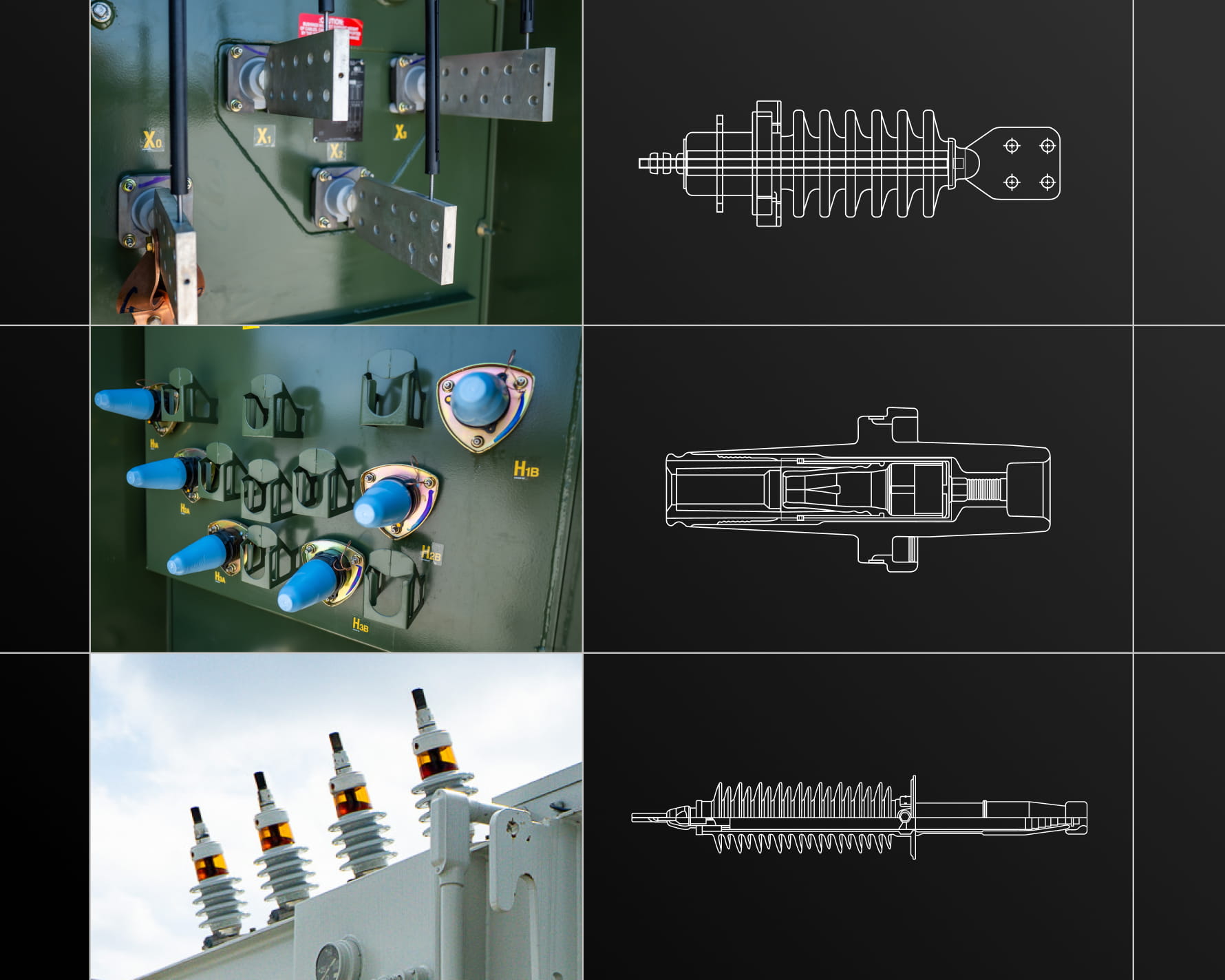
There are two main types of distribution arresters: ones for dead-front bushings and ones for live-front bushings. 

Graphic of arresters that attach to live-front and dead-front bushings

Distribution Class Arresters for Dead-Front Bushings

Dead-front elbow arresters can be either 200-amp loadbreak style or 600-amp deadbreak style arresters. Both of these connect directly into the dead-front bushings on a padmount or substation. In some cases, you can use an adapter or reducing tap plug to connect 600-amp bushings to 200-amp arresters, like in the picture below on the left.
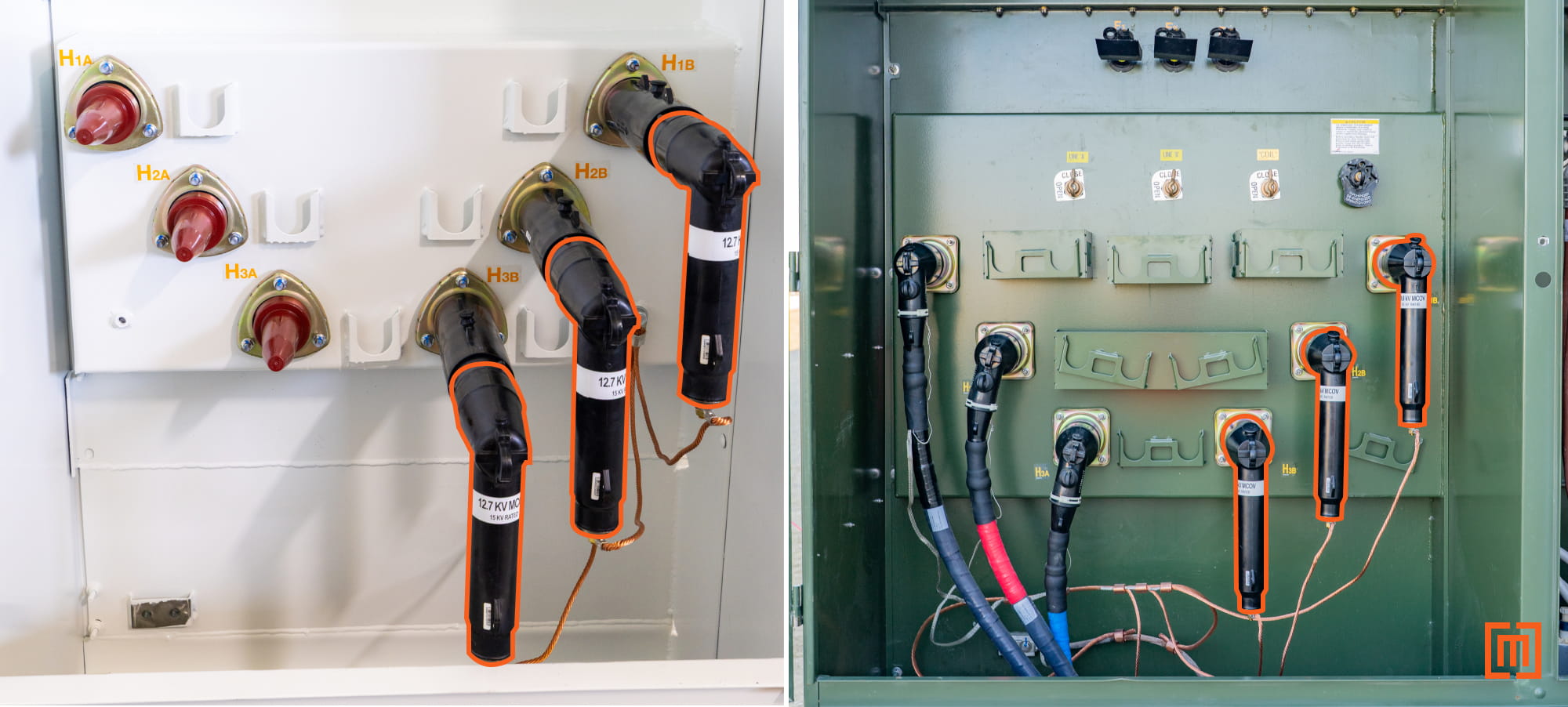
photos of dead-front arresters on loop-feed padmounts

Distribution Class Arresters for Live-Front Bushings

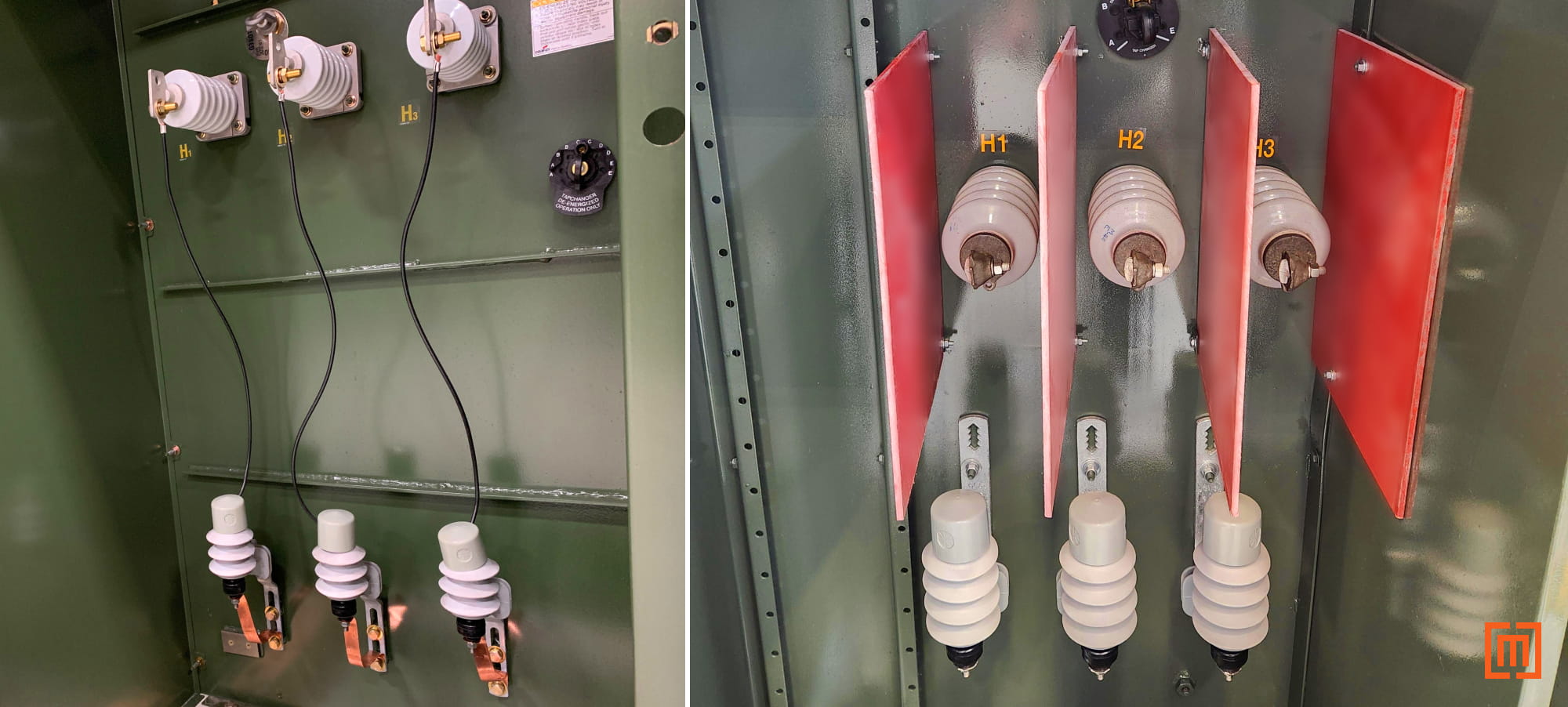
Distribution class arresters can also be paired with live-front bushings on polemounts, substations, and padmounts. A wire attaches from the bushing spade to the arrester, and the arrester is grounded to the tank through a copper ground strap. 
photos of live-front arresters on padmounts

Intermediate Arresters

Intermediate arresters are rated between 3 kV and 120 kV. They are usually located on substation transformers on mounting provisions near the primary bushings. Intermediate arresters can handle grounding fault currents of up to 10 kA.
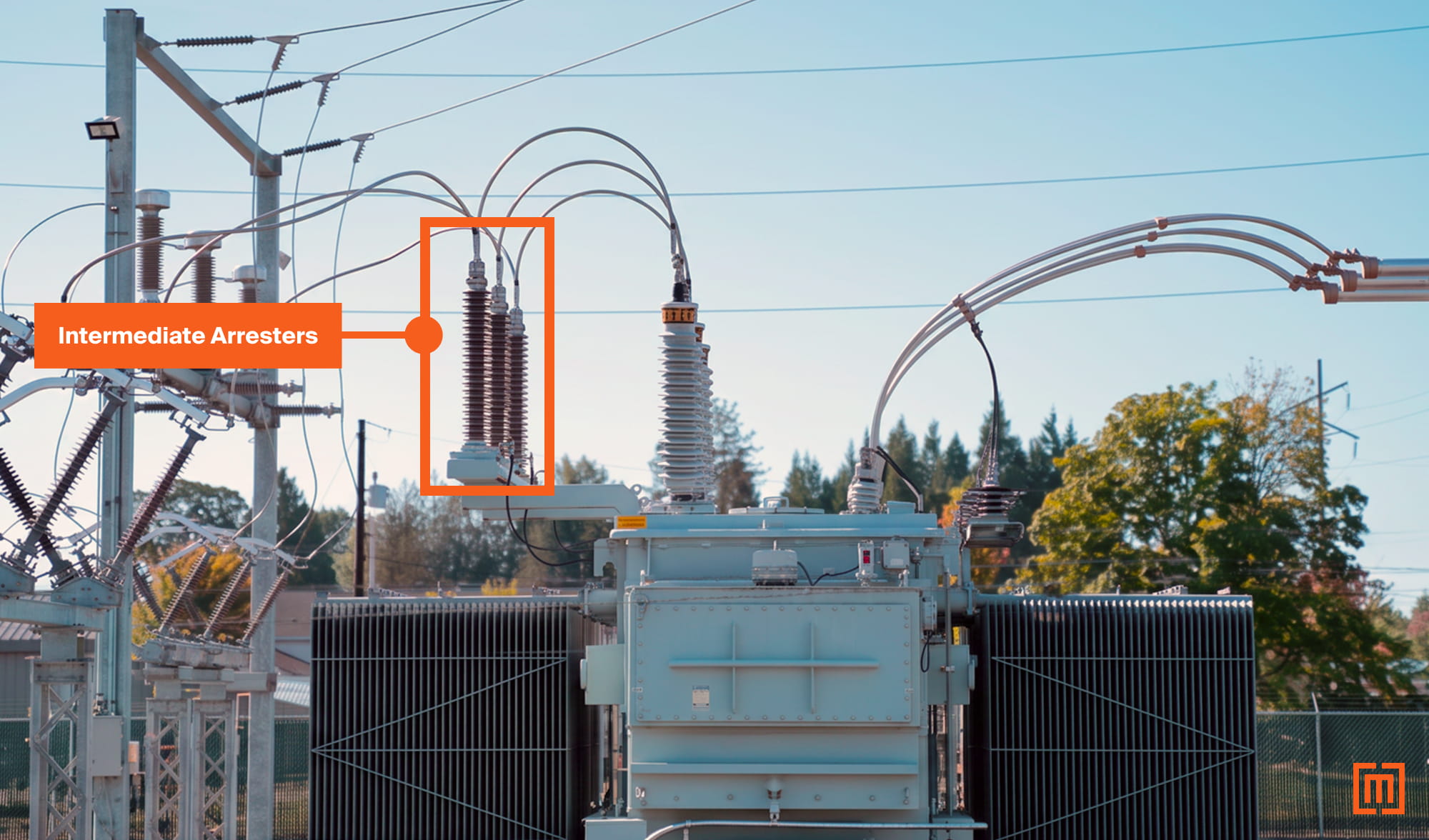
photo of substation with intermediate arresters

Station Class Arresters

Station class arresters are mainly used on power class substations. These are designed for applications requiring massive amounts of power. These arresters protect against the highest overvoltages, and are available in ratings all the way up to 684 kV.
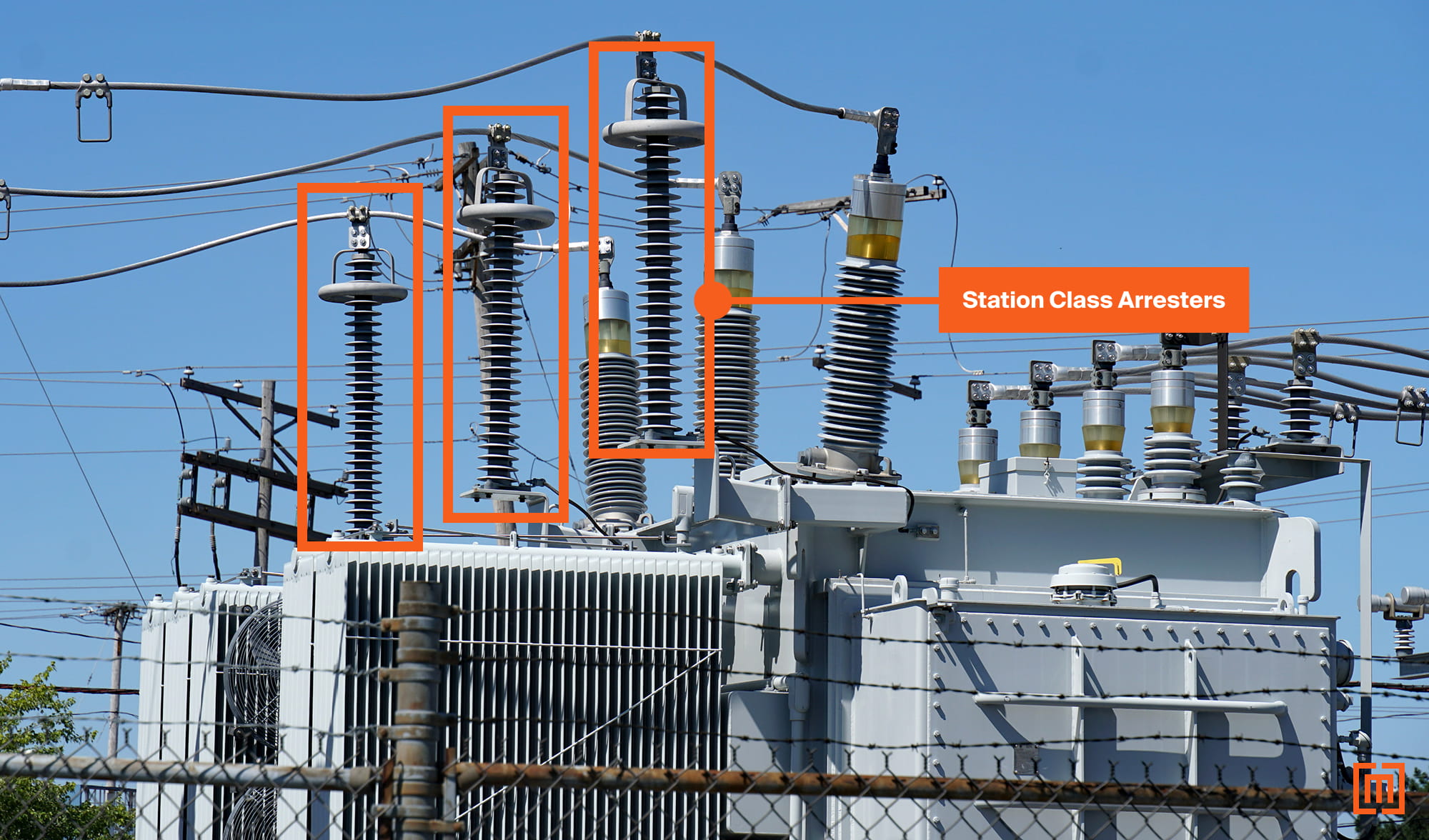
photo of substation with station class arresters

How do you choose the right arrester? 

It’s standard to have arresters throughout the power system to protect against voltage spikes and protect power quality. But there are lots of different types of arresters. How do you choose the right one? There are at least two things you need to think through here: 

1. Examine the bushing class and design. 

Since arresters connect to transformer bushings, you’ll need to examine the type of bushing and the design of the bushing. Whether your bushings are live-front or dead-front will determine if additional components are needed. 

Dead-Front Bushings

Dead-front bushings require elbow arresters that plug directly onto the primary bushings. 

The voltage class of the elbow connector must match the voltage class of the bushings. Each dead-front bushing interface has a distinct tip color to prevent mismatching. 15 kV bushings have red tips, 25 kV bushings have blue tips, and 35 kV bushings can have a purple cuff (for a large interface) or a yellow tip (for a small interface).

Amperage also matters. Dead-front bushings are usually either 200 or 600 amps.

A 200-amp elbow arrester can connect directly to a 200-amp interface. However, it cannot plug directly into a 600-amp deadbreak interface.

For a 600-amp system, a reducing tap plug can be used to adapt the 600-amp interface to a 200-amp connection.

You also need to make sure there is enough space inside the transformer cabinet for the additional depth of the adapter and arrester.

diagram of reducing tap plug with bushing extender

Live-Front Bushings

Live-front bushings have exposed terminals. Because those connections are exposed, proper electrical clearances are especially important. Live-front arresters are normally mounted to the transformer tank using steel brackets.

A conductor connects the primary bushing to the arrester, while a ground strap connects the arrester to the tank and provides a low-impedance path to ground.

2. Determine the Correct Arrester Ratings  

Once you’ve matched your bushings, you need to determine which rating works best for your system. Arrester ratings are always based on the power source the transformer is being fed from. Not the transformer itself. This means you’ll need to figure out exactly how your power system is set up.

This brings us to the Maximum Continuous Operating Voltage (MCOV) rating. To reduce the risk of premature failure, make sure the arrester is sized to handle the line-to-ground voltage in the power system. Understanding how your system is grounded is the absolute key to picking the right MCOV, because grounding dictates the voltages the arrester will see line-to-ground. 

Solidly Grounded Systems

If your system is solidly grounded, the continuous voltage experienced by the arrester will usually be no higher than the line-to-neutral voltage in the system. 

Ungrounded Systems

If your system is ungrounded, the voltage can spike much higher. In these setups, the maximum line-to-ground voltage can be as high as the line-to-line value. 

Knowing your power system's grounding layout is the only way to select the correct MCOV and ensure your arresters don't get overloaded and fail during standard operations.

The Right Arrester

Choosing the right arrester is an important part of protecting your power system.

An arrester rating that’s too high won’t fail easily, but may allow a larger voltage surge to reach the equipment before it begins limiting the voltage. 

An arrester rating that’s too low will provide superior protection, but it will risk premature failure. The key is balancing those two aspects to get the right rating for your system. 

If you need transformers, arresters, or any other transformer parts fill out the form below. We’ve got thousands of units and parts in stock across the USA ready to get your project online.

Written by:
Matt Estelle and Ben Gulick
A Maddox Padmount transformer loaded on a truck and shipping out

Get in touch

Find out how Maddox can power on your next project.
Thank you!
Your submission has been received!
Oops! Something went wrong while submitting the form.
All Articles

Transformer Arrester Guide: Types, Ratings & Protection

Learn how transformer arresters protect electrical equipment from lightning and switching surges, the main arrester types, and how to choose the right one.

Written by:
Matt Estelle and Ben Gulick

September 28, 2026

closeup of arresters on a green loop-feed padmount transformer

‍Transformers do a lot of heavy lifting on the power grid. But they still need protection from electrical hazards if you want the power to stay on. Devices like Switchgear, vacuum interrupters, fuses, and surge arresters all help protect transformers and the electrical systems connected to them.

While fuses deal with overcurrent, arresters deal with large voltage spikes. 

Arresters do protect the transformer, but their main job is to protect the user’s load. (Whatever is consuming the power downwind of the transformer.) A transformer can often withstand a brief voltage surge, but the equipment connected downstream may be much more sensitive. Arresters help limit those surges before they damage the transformer or other connected equipment.

In this article, we’ll explain what transformer arresters are, how they work, the main types, and what to consider when choosing one.

What is a transformer arrester?

An arrester, also called a surge protector or a lighting arrester, is a protective device that limits temporary overvoltage in an electrical system. 

It works much like the surge protector you might use for your laptop or other electronics. When voltage suddenly rises above the normal level, the arrester redirects the surge to ground before it can damage connected equipment.

What does an arrester protect against? 

Surge arresters protect electrical equipment from large, temporary voltage spikes.

Two of the most common overvoltage sources are lightning surges and switching surges.

Lightning Surges

A lightning strike doesn’t have to hit your transformer to create a problem.

A strike on or near an overhead distribution line can create a traveling voltage wave that moves through the electrical system toward the transformer and connected equipment. Without adequate surge protection, that transient voltage can damage the electrical system. 

photo of lightning around power lines against a purple sky

This is why surge arresters are often referred to as lightning arresters.

Switching Surges

Opening and closing electrical circuits can also create temporary overvoltages.

Switchgear, capacitor banks, and other power-system equipment can produce transient voltage that travels through the system.

Surge arresters can help limit these overvoltages before they reach damaging levels. 

How do transformer arresters work? 

Under normal operating conditions, an arrester does very little.

When voltage suddenly rises above its normal range, the arrester responds by limiting, or “clamping,” the overvoltage by diverting the surge to earth ground.

diagram of substation with arresters showing voltage diverted to ground

Metal Oxide Varistars

The part of the arrester that does this clamping and protecting is the metal oxide varistar or MOV. 

MOV blocks are designed to handle voltage surges within a specific range. When a large voltage surge reaches the arrester, the MOVs divert that surge to ground.

However, there is a limit to how much voltage and energy they can withstand.

Two important arrester ratings help define those limits:

  • Duty-cycle rating
  • Maximum Continuous Operating Voltage, or MCOV

Duty-Cycle Rating

MOV’s withstand rating, or duty cycle, is the voltage level an arrester is designed to withstand during short-duration overvoltage conditions.

When the temporary overvoltages are higher than the arrester’s duty cycle rating, the MOVs fail.

Maximum Continuous Operating Voltage

MOVs are also designed to handle the continuous normal system voltage. This is the voltage they experience within the standard supply voltage range. Exposing the MOVs to long periods of higher than normal voltages also causes failure. We call this rating the maximum continuous operating voltage (MCOV). 

Getting the right arrester requires correctly sizing the duty cycle and MCOV ratings. Otherwise, the arrester may not properly protect the transformer and electrical system. The higher the regular voltage is, the greater the potential overvoltage. 

What are the types of arresters?

There are three main types of arresters: distribution, intermediate, and station class. 

The table below has a quick breakdown of these different types.

Characteristic Distribution Class Intermediate Class Station Class
Applications Padmount & polemount transformers, riser poles, and standard overhead utility lines Small-to-medium substations, and medium-voltage equipment Large utility substations, and high-voltage transmission terminals
Voltage Range 1-36 kV 3-120 kV 3-684 kV
Short-Circuit Rating Up to 20 kA (20,000 Amps) for 12 cycles Up to 40 kA (40,000 Amps) Up to 63 kA (63,000 Amps)
Energy Durability Evaluated via High-Current Withstand (65 kA to 100 kA) rather than switching surge energy class Moderate-to-high switching surge energy capabilities Highest switching surge energy and thermal handling capacity

Distribution Arresters

Distribution arresters are rated from 1 kV up to 36 kV They are usually used on padmounts, polemounts, and substations. 

There are two main types of distribution arresters: ones for dead-front bushings and ones for live-front bushings. 

Graphic of arresters that attach to live-front and dead-front bushings

Distribution Class Arresters for Dead-Front Bushings

Dead-front elbow arresters can be either 200-amp loadbreak style or 600-amp deadbreak style arresters. Both of these connect directly into the dead-front bushings on a padmount or substation. In some cases, you can use an adapter or reducing tap plug to connect 600-amp bushings to 200-amp arresters, like in the picture below on the left.

photos of dead-front arresters on loop-feed padmounts

Distribution Class Arresters for Live-Front Bushings

Distribution class arresters can also be paired with live-front bushings on polemounts, substations, and padmounts. A wire attaches from the bushing spade to the arrester, and the arrester is grounded to the tank through a copper ground strap. 

photos of live-front arresters on padmounts

Intermediate Arresters

Intermediate arresters are rated between 3 kV and 120 kV. They are usually located on substation transformers on mounting provisions near the primary bushings. Intermediate arresters can handle grounding fault currents of up to 10 kA.

photo of substation with intermediate arresters

Station Class Arresters

Station class arresters are mainly used on power class substations. These are designed for applications requiring massive amounts of power. These arresters protect against the highest overvoltages, and are available in ratings all the way up to 684 kV.

photo of substation with station class arresters

How do you choose the right arrester? 

It’s standard to have arresters throughout the power system to protect against voltage spikes and protect power quality. But there are lots of different types of arresters. How do you choose the right one? There are at least two things you need to think through here: 

1. Examine the bushing class and design. 

Since arresters connect to transformer bushings, you’ll need to examine the type of bushing and the design of the bushing. Whether your bushings are live-front or dead-front will determine if additional components are needed. 

Dead-Front Bushings

Dead-front bushings require elbow arresters that plug directly onto the primary bushings. 

The voltage class of the elbow connector must match the voltage class of the bushings. Each dead-front bushing interface has a distinct tip color to prevent mismatching. 15 kV bushings have red tips, 25 kV bushings have blue tips, and 35 kV bushings can have a purple cuff (for a large interface) or a yellow tip (for a small interface).

Amperage also matters. Dead-front bushings are usually either 200 or 600 amps.

A 200-amp elbow arrester can connect directly to a 200-amp interface. However, it cannot plug directly into a 600-amp deadbreak interface.

For a 600-amp system, a reducing tap plug can be used to adapt the 600-amp interface to a 200-amp connection.

You also need to make sure there is enough space inside the transformer cabinet for the additional depth of the adapter and arrester.

diagram of reducing tap plug with bushing extender

Live-Front Bushings

Live-front bushings have exposed terminals. Because those connections are exposed, proper electrical clearances are especially important. Live-front arresters are normally mounted to the transformer tank using steel brackets.

A conductor connects the primary bushing to the arrester, while a ground strap connects the arrester to the tank and provides a low-impedance path to ground.

2. Determine the Correct Arrester Ratings  

Once you’ve matched your bushings, you need to determine which rating works best for your system. Arrester ratings are always based on the power source the transformer is being fed from. Not the transformer itself. This means you’ll need to figure out exactly how your power system is set up.

This brings us to the Maximum Continuous Operating Voltage (MCOV) rating. To reduce the risk of premature failure, make sure the arrester is sized to handle the line-to-ground voltage in the power system. Understanding how your system is grounded is the absolute key to picking the right MCOV, because grounding dictates the voltages the arrester will see line-to-ground. 

Solidly Grounded Systems

If your system is solidly grounded, the continuous voltage experienced by the arrester will usually be no higher than the line-to-neutral voltage in the system. 

Ungrounded Systems

If your system is ungrounded, the voltage can spike much higher. In these setups, the maximum line-to-ground voltage can be as high as the line-to-line value. 

Knowing your power system's grounding layout is the only way to select the correct MCOV and ensure your arresters don't get overloaded and fail during standard operations.

The Right Arrester

Choosing the right arrester is an important part of protecting your power system.

An arrester rating that’s too high won’t fail easily, but may allow a larger voltage surge to reach the equipment before it begins limiting the voltage. 

An arrester rating that’s too low will provide superior protection, but it will risk premature failure. The key is balancing those two aspects to get the right rating for your system. 

If you need transformers, arresters, or any other transformer parts fill out the form below. We’ve got thousands of units and parts in stock across the USA ready to get your project online.

A Maddox Padmount transformer loaded on a truck and shipping out

Get in touch

Find out how Maddox can power on your next project.
Thank you!
Your submission has been received!
Oops! Something went wrong while submitting the form.